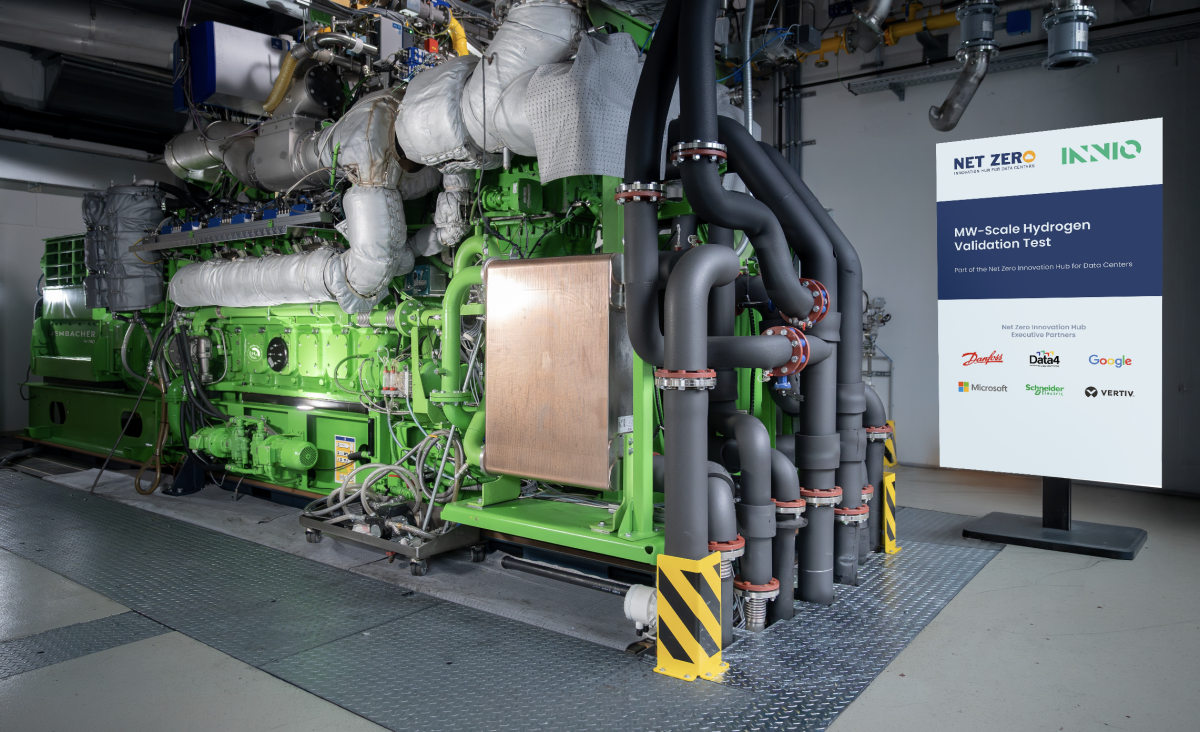
INNIO Group, in partnership with the Net Zero Innovation Hub for Data Centers, recently completed a demonstration of backup power solutions using 100% hydrogen-fuelled engines at the 3 MW scale. The project is intended to test hydrogen-based approaches for data centre backup power.
The collaborative approach of the Innovation Hub involved participation from experts from Microsoft, Google, and Data4, who witnessed the live tests. Their presence supported assessment of whether the system met operational requirements for data centres.
INNIO’s natural gas engines, known for rapid start-up and stable performance, were operated using hydrogen to assess performance under data centre conditions.
The Jenbacher engine was tested during 3 MW-class trials at INNIO’s research facility. Testing included AI load profiles and rapid load fluctuations. The results were used to evaluate hydrogen engines as a potential backup option for data centre operations.
Findings from the structured innovation process reflect ongoing industry activity related to decarbonisation. Following an international Request for Information (RFI), clean fuels including hydrogen were identified as potential alternatives to diesel generators for data centre backup power.
The Innovation Hub, supported by organisations including Data4, Google, and Microsoft, enabled MW-scale validation of the technology. The collaboration is part of wider efforts to explore scalable approaches within the sector.
With AI-driven demand increasing, interest in low-carbon backup power solutions for data centres is also growing. Analysts estimate that hybrid energy systems could increase from 10–20% in 2025 to 50–60% by 2030, reflecting a shift away from diesel.
Hydrogen-based systems are being explored as options for backup and prime power, alongside considerations such as infrastructure, storage, and dual-fuel capability. These areas remain part of ongoing development work by INNIO Group and the Innovation Hub.
Looking ahead, the collaboration may contribute to further exploration of hydrogen’s role in energy solutions for the digital economy. The development is one of several steps in the evaluation of low-carbon options for data centre power systems.