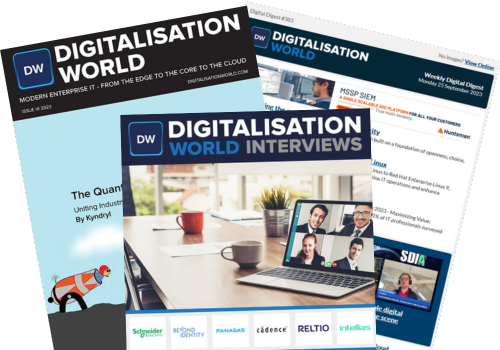
Digital Newsletter
Each week our editor Phil Alsop rounds up the most popular articles, videos and expert opinions. We compile this into a Digital Newsletter and send it straight to your inbox every week.
Digital Magazines
We'll let you know each time a new edition of Digitalisation World is released so that you're always kept up-to-date with the latest and greatest news and press releases.
Video Magazines
The Digitalisation World Video magazine contains the latest Zoom interviews with experts in the industry.
Progress has published the results of its global survey, “Human-Centered Software Design: A State of the Marketplace Report.” Sponsored by Progress and conducted by independent research firm Insight Avenue, the survey is based on interviews with more than 700 application developers and IT decision-makers worldwide. The purpose of the survey is to offer insights into businesses’ approaches and levels of maturity in building human-centric applications amidst the increasing importance of accessibility. The full report and findings can be found here.
Human-centered application development refers to building applications and websites that are easy and comfortable to navigate across a diverse community of users. They should address the specific needs of people, including those with differing abilities, demographics and personality factors as well as diverse language and cultural backgrounds and more. With the European Union and the United States introducing legislation for businesses to provide equal access to digital services for all and a socioeconomic culture driven by inclusive best practices, inaction is no longer an option.
Although nearly every organisation participating in the research acknowledged the importance of human-centric app development, a wide disparity existed between intent and action. While 98% of the respondents stated it was important, only 34% are currently addressing the issue through tools, training and policy. As barriers, the respondents mentioned the speed of development while meeting customer demands at the same time (42%), complexity and lack of agility (41%) and lack of in-house skills (29%).
The survey findings also show:
• 76% of respondents consider building human-centric applications more important than it was two years ago, driven by a combination of business considerations and cultural shifts
• 56% stated it is a major need and plan to invest in human-centric applications in the next 12–18 months
• 86% said it was harder to retrofit inclusion and accessibility into existing applications than factoring them into new applications from the start
• An average of only 59% of current applications in surveyed organisations are estimated to meet accessibility requirements
• 97% of those surveyed are experiencing human-centricity adoption challenges
The survey results also show that organisations are losing ground to competitors because of confusion around the tools and processes needed to proactively create human-centric design. Various tooling solutions were referenced by survey respondents, including AI and machine learning, chatbots, assistive technology for motor disabilities, color contrast checking and more. In addition, to make further inroads, organisations need training, improved collaboration and cost-effective approaches. They need to identify and work with partners and suppliers who prioritise essential protocols and metrics around inclusion and accessibility.
“Creating human-centric digital experiences means personalising experiences and tailoring them to both people and their context, so they are as relevant as possible. It also means making those experiences accessible to a broader range of people with a broader range of needs and abilities,” said Loren Jarrett, EVP & GM, Digital Experience, Progress. “At Progress, we are committed to helping organisations proactively invest to build more inclusive, contextual and tailored digital products.”