A market redefining its foundations
As the industry continues to evolve, one thing is clear: in the age of AI, data resilience is quickly becoming the new baseline.
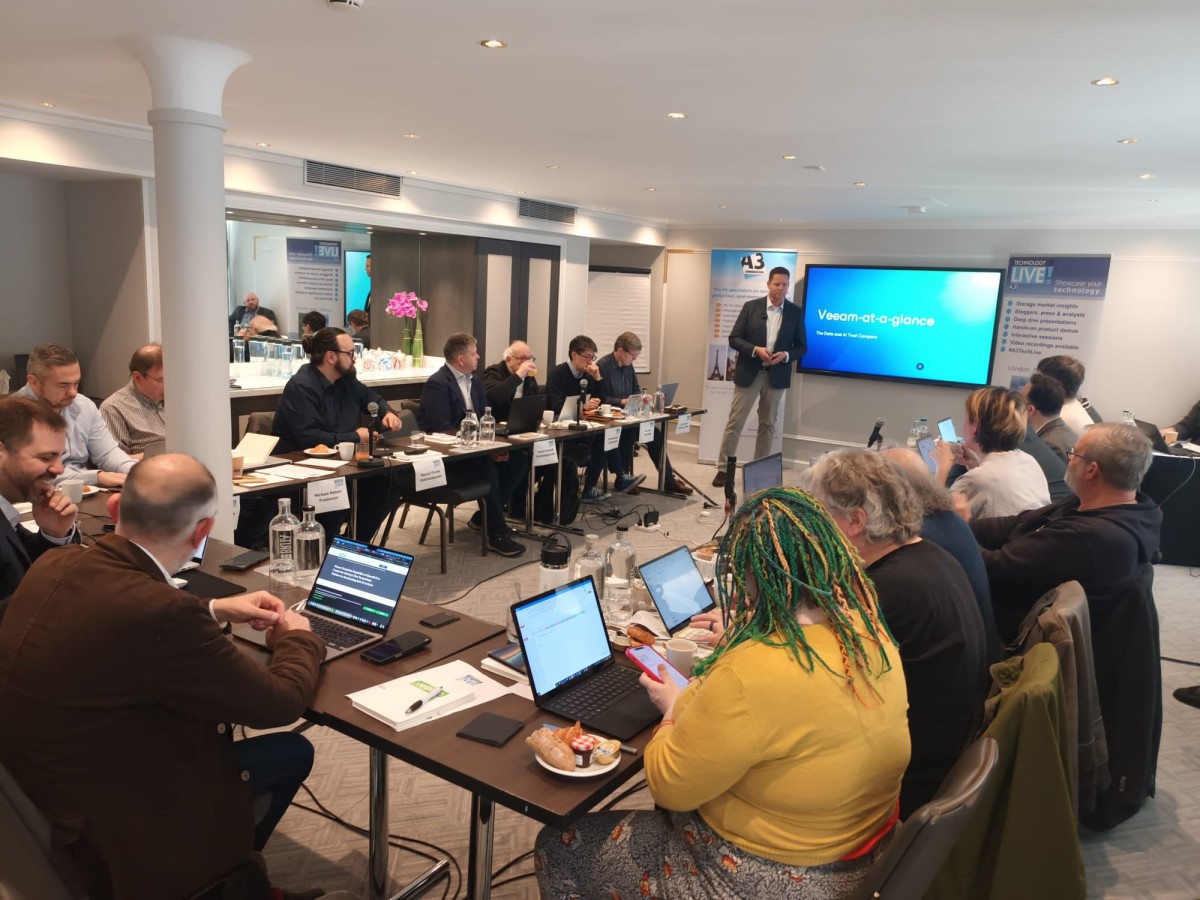
That message set the tone at Technology Live! in Paris, where infrastructure and data protection vendors gathered to discuss how organisations are reshaping data strategies under pressure from AI, cyber risk, and increasing complexity.
Presenting vendors were NGX Storage, an enterprise storage provider; Keepit, a SaaS data protection specialist; Veeam, the data and AI trust company; and HYCU, focused on multi-cloud and SaaS data protection. Their messaging converged around shared challenges, including explosive data growth, fragmentation, rising security threats, and the operational demands of AI.
Alongside these themes, the four vendors also signalled how their platforms are evolving, from AI-driven protection and expanded SaaS coverage to new storage and memory architectures and deeper integration between security and resilience.
From backup to resilience in a SaaS-driven world
Across the event, the shift from traditional backup to full-scale resilience was clear, with vendors reframing resilience as an operational capability that ensures availability, integrity, and recoverability across hybrid and multi-cloud environments.
This shift is closely tied to the changing nature of enterprise data. As SaaS adoption accelerates, critical information is increasingly distributed across applications outside traditional infrastructure boundaries, emphasising the need for continuous availability, rapid recovery, and operational continuity across complex environments.
“More SaaS applications means more data outside organisations and a greater challenge in maintaining control,” said Kim Larsen, CISO at Keepit.
“Hope is not a strategy,” Larsen added, emphasising the need for proactive resilience planning.
Industry forecasts presented on the day suggest that by 2029, 80% of enterprises will prioritise SaaS backup as a critical requirement, up from just 20% in 2025.
Keepit has just published its Keepit Annual Data Report 2026, which highlights the path from SaaS adoption to proven recovery readiness. Based on anonymised, aggregated behavioural production data, the report provides further insight into recovery patterns.
Operational trends show that 95% of enterprise organisations performed at least one restore in 2025, and that the most popular recovery activity is frequent and granular, with most incidents involving small, urgent restores, while identity-related recovery remains a key blind spot.
AI reshaping both infrastructure and risk
AI emerged as both a catalyst for innovation and a driver of new risk, reshaping requirements across infrastructure and security.
NGX Storage used Technology Live! to highlight its ExaScale platform, a scale-out NVMe architecture designed to deliver microsecond latency and high throughput for AI and HPC workloads. The company also pointed to its production readiness and ongoing development of a next-generation unified storage platform.
“AI workloads require a new storage architecture - high-performance and built for extreme data scale,” said Pradeep Ganesan, Engineering Director at NGX Storage.
At the same time, AI is changing the threat landscape: rather than targeting infrastructure directly, attackers are increasingly exploiting identities, further emphasising this blind spot.
“Attackers no longer need to break in - they log in,” said Rick Vanover, VP of Product Strategy at Veeam.
According to data shared during the session, 93% of cyberattacks now target identity-based vulnerabilities, while AI-powered tools are accelerating data exfiltration.
The result is what vendors described as an emerging “AI trust gap,” where adoption is outpacing governance and protection capabilities.
To address this, Veeam highlighted its acquisition of Securiti AI, enabling it to combine data resilience with data intelligence and AI-driven security. The move reflects a broader shift toward unifying backup, security and governance into a single, integrated approach.
Fragmentation as the underlying challenge
While AI is accelerating change, fragmentation remains the underlying issue.
Enterprises are managing data across SaaS platforms, cloud environments, on-prem systems, and AI datasets, creating environments where data is distributed, inconsistently protected, and difficult to govern.
HYCU described this as a “fragmented data estate,” highlighting both operational complexity and risk. The company cited figures showing that 65% of organisations experienced a SaaS data breach in the past year, with downtime costing an average of $405,770 per day and recovery taking up to five working days.
“Resilience used to mean uptime. Today it means control,” said Wendy Inwood, HYCU EMEA Channel Chief, reflecting a shift from keeping systems online to ensuring organisations can see, secure, and recover their data across increasingly fragmented environments.
As part of its response, HYCU is expanding its platform, including the introduction of Legal 360, a solution designed to protect the full lifecycle of legal data across fragmented systems, highlighting a broader move toward verticalised data protection.
From a storage perspective, fragmentation is also creating inefficiencies. “Companies spend more time managing storage than using their data,” said Beyhan Çalışkan, CEO of NGX Storage, pointing to the continued separation of NAS, SAN, and object storage as a source of complexity that increases costs and diverts resources.
Convergence, control and sovereignty
In response, vendors are increasingly aligned around simplification and consolidation.
“Global instability is driving customer demand for data control, locality and ownership,” said Thierry Bedos, Area VP, South EMEA at Keepit.
Whether through unified storage, vendor-independent backup or integrated protection platforms, the direction is toward reducing fragmentation and centralising control. Vendors are also expanding SaaS coverage, enhancing AI-driven capabilities and supporting more flexible deployment models.
This convergence is closely linked to the growing importance of data sovereignty, particularly in Europe, where organisations are placing greater emphasis on control, locality, and ownership.
At the same time, vendors are promoting independence from hardware, cloud providers, and SaaS platforms as a way to reduce lock-in and increase flexibility.
Resilience as the foundation for AI-driven enterprise
Taken together, the discussions at Technology Live! in Paris point to a broader transformation in how enterprise data is managed.
The boundaries between storage, backup, security, and governance are becoming less distinct, as organisations look for integrated platforms that deliver visibility, protection, and recovery across the data lifecycle. Resilience is also being redefined as a prerequisite for trust, particularly as data underpins AI-driven decision-making.
“There is no AI without data security, and no trust in AI without data resilience,” said Tim Pfaelzer, GM and SVP EMEA at Veeam.
For enterprises, the challenge lies in balancing innovation with control, compliance, and trust. For vendors, the opportunity is to simplify that complexity while enabling AI-driven workloads.
The conversations in Paris made it clear that resilience is no longer a differentiator, but the foundation on which modern, AI-enabled organisations must build.